When feeding your dog or cat raw meat, also known as barf, you need to put together the meals so that they together form the perfect prey.
You don't have to mix it all up every day, but you should make sure it gets through all the meat groups found on the prey:
- Muscle meat
- Offal
- Cartilage
- Tripe/gizzard
If this is the first time you are offering your dog raw meat, you can start with tripe.
Tripe helps the dog's stomach adjust to the raw food, and when a "black and slimy wood snail" comes out the other end, the stomach is ready for the next variant. Tripe contains digestive enzymes, which are especially useful if your dog has a sensitive stomach.
You can also choose to start with a pure meat product, i.e. something without cartilage, so that the stomach does not have to work too hard at the first raw meal. Not so much for the dog's sake, but more for your sake. Then you have a chance to be able to pick up the feces.

If you can't figure out how to mix the different meat groups yourself, then RigtigHundemad has made it easy for you.
There are several variants in both 500 g blocks and 1 and 2 kg bags of loose frost, where RigtigHundemad has mixed "whole animals in the bag".
Also read the blog about Nønne & Coco's start-up with barf feeding
Can my dog have meat bones?
If your dog has not had raw meat bones before, it may be a good idea to get his stomach used to the raw meat first, so that digestion works optimally. So when the stool is fine, you can serve food with cartilage and bones. After three months of raw, the dog is able to digest whole meat bones on its own. However, it is always a good idea to use soft bones and cartilage, as load-bearing bones (the hard bones) can be hard on the teeth. Soft bones and cartilage count as part of the meal, where hard bones are considered activation.
How much should my dog have?
The most important thing is that you look at your dog and assess whether he is getting too little or too much!
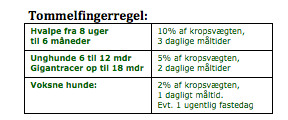
If your female is a little too heavy, start from the DESIRED weight!
The good thing about raw feeding/barfing your dog with Real Dog Food is that even though it is on a diet, the dog still gets twice as much food in the bowl as when it was fed dry food.
This is due to the natural content of meat juices, which can make up up to 70% of the product, and is an essential part of the meal. You will also find that when you feed your dog raw meat, he drinks less water, simply because there is plenty of liquid in the food. On the other hand, he drinks a lot when eating meat bones!
So always make sure your dog has access to fresh water.
At Rigtig Hundemad, it is recommended that you supplement with a vitamin and mineral mixture, such as Anibio Min-O-Vit or BARF Complex.
If the coat is dull and sad, a supplement of fat or oil may also be recommended, such as Grizzly wild salmon oil.
Welcome and have a great time!
Many greetings
Lene Friis
Owner of RealDogFood
P.S.
You can hear much more about raw feeding, get good advice for getting started and meet Lene Friis at DogDay on October 8, 2016, where RigtigHundemad will be present during the entire event with a stand .
See here how to get involved .
Guide: Getting started with raw feeding
When feeding your dog or cat raw meat, also known as barf, you need to put together the meals so that they together form the perfect prey.
You don't have to mix it all up every day, but you should make sure it gets through all the meat groups found on the prey:
If this is the first time you are offering your dog raw meat, you can start with tripe.
Tripe helps the dog's stomach adjust to the raw food, and when a "black and slimy wood snail" comes out the other end, the stomach is ready for the next variant. Tripe contains digestive enzymes, which are especially useful if your dog has a sensitive stomach.
You can also choose to start with a pure meat product, i.e. something without cartilage, so that the stomach does not have to work too hard at the first raw meal. Not so much for the dog's sake, but more for your sake. Then you have a chance to be able to pick up the feces.
If you can't figure out how to mix the different meat groups yourself, then RigtigHundemad has made it easy for you.
There are several variants in both 500 g blocks and 1 and 2 kg bags of loose frost, where RigtigHundemad has mixed "whole animals in the bag".
Also read the blog about Nønne & Coco's start-up with barf feeding
Can my dog have meat bones?
If your dog has not had raw meat bones before, it may be a good idea to get his stomach used to the raw meat first, so that digestion works optimally. So when the stool is fine, you can serve food with cartilage and bones. After three months of raw, the dog is able to digest whole meat bones on its own. However, it is always a good idea to use soft bones and cartilage, as load-bearing bones (the hard bones) can be hard on the teeth. Soft bones and cartilage count as part of the meal, where hard bones are considered activation.
How much should my dog have?
The most important thing is that you look at your dog and assess whether he is getting too little or too much!
If your female is a little too heavy, start from the DESIRED weight!
The good thing about raw feeding/barfing your dog with Real Dog Food is that even though it is on a diet, the dog still gets twice as much food in the bowl as when it was fed dry food.
This is due to the natural content of meat juices, which can make up up to 70% of the product, and is an essential part of the meal. You will also find that when you feed your dog raw meat, he drinks less water, simply because there is plenty of liquid in the food. On the other hand, he drinks a lot when eating meat bones!
So always make sure your dog has access to fresh water.
At Rigtig Hundemad, it is recommended that you supplement with a vitamin and mineral mixture, such as Anibio Min-O-Vit or BARF Complex.
If the coat is dull and sad, a supplement of fat or oil may also be recommended, such as Grizzly wild salmon oil.
Welcome and have a great time!
Many greetings
Lene Friis
Owner of RealDogFood
P.S.
You can hear much more about raw feeding, get good advice for getting started and meet Lene Friis at DogDay on October 8, 2016, where RigtigHundemad will be present during the entire event with a stand .
See here how to get involved .