Over the next two blogs you will find 8 steps that I most often recommend practicing when cutting nails.
Some dogs need more steps - some less. What all steps have in common is that you need to watch your dog. See how he reacts to the training and continually reevaluate your plan.
Only move on when your dog is comfortable with the training you are doing and don't be afraid to ease up again if you have progressed too quickly. Also remember that your dog's daily form may vary from day to day - some days your dog may be fully engaged in the training and other days he may want to be free.

So: look at your dog, be curious about its signals and respect what it is trying to tell you.
One of the things you need to practice to achieve safe nail clipping is, of course, handling the paws. But today I will give you 4 exercises that you can practice without touching the paws - and they will all get you closer to safe nail clipping.
Haven't read part 1? You can find it here
- Safe handling location
Choose a specific place in your home where you will only practice safe and positive handling from now on - a special rug, a specific corner of the living room or similar. Your dog will learn that in this place, handling always happens on its terms. If at some point you have to expose your dog to 'must handling', this should be done far away from your 'safe handling place'.
- Objects
There are several ways to teach your dog to be comfortable with nail clippers. One of them is to practice using the nail clippers along with several other objects that the dog has a good or neutral relationship with. Start the 'play' with a series of objects that your dog is comfortable with. Show the objects to your dog one at a time and reward your dog for looking and/or interacting with the object.
Once your dog is familiar with the safe object system, you can start to occasionally show the nail clippers and reward them for looking at and/or interacting with the nail clippers. Always keep the objects still and let your dog decide whether to interact with them.
The goal is for your female to learn that the sight of objects - and later the nail clippers - predicts that something good will happen = that treats will come.
- Sound
Now you need to start cutting the pasta. I have tried different types and have found that with most nail scissors, small soup horn pasta sounds most like a nail being cut.
Every time you cut a piece of pasta, you have to throw a treat to your dog. Your dog chooses how far away he wants to be from you and the nail clippers+pasta, so you just have to throw the treat where your dog is.
This exercise both teaches your dog that the sound of a nail/pasta being clipped predicts something good = a treat, and at the same time it shows your dog that the nail clippers can be 'in action' without anything unpleasant happening to the dog.
Over time, when your dog has become comfortable with the 'play' and chooses to stay close to you while you cut the paste, you can start moving the nail clippers around before cutting the paste. Cut the paste closer and closer to the dog and eventually closer and closer to the dog's paws.
- Handling face
Along with the other steps, you can train your 'handling face'. For many of us, as long as we're just training, our faces look relaxed - and as soon as we think about cutting a nail, we start to concentrate and look serious. Our dogs can see the difference, of course. So practice looking concentrated occasionally while you're training, so your dog learns that that face doesn't predict anything unpleasant.
HEP and good training from me to you!
– Mie
Success Dog - Mie Bay
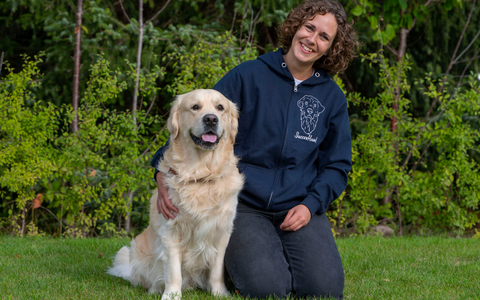
Mie Bay is a veterinarian, dog trainer and huge dog nerd. She is passionate about the good relationship between dog and owner and has a particular passion for spreading training in safe and voluntary handling for the family dog. Mie owns SuccesHund, where she works according to the idea that dog training should be safe and fun - for both dog and human.
You can read about Mie's teaching and get to know her better on the Instagram/Facebook profiles @SuccesHund and on the websitewww.succeshund.dk
Safe Nail Clipping - part 2
Over the next two blogs you will find 8 steps that I most often recommend practicing when cutting nails.
Some dogs need more steps - some less. What all steps have in common is that you need to watch your dog. See how he reacts to the training and continually reevaluate your plan.
Only move on when your dog is comfortable with the training you are doing and don't be afraid to ease up again if you have progressed too quickly. Also remember that your dog's daily form may vary from day to day - some days your dog may be fully engaged in the training and other days he may want to be free.
So: look at your dog, be curious about its signals and respect what it is trying to tell you.
One of the things you need to practice to achieve safe nail clipping is, of course, handling the paws. But today I will give you 4 exercises that you can practice without touching the paws - and they will all get you closer to safe nail clipping.
Haven't read part 1? You can find it here
Choose a specific place in your home where you will only practice safe and positive handling from now on - a special rug, a specific corner of the living room or similar. Your dog will learn that in this place, handling always happens on its terms. If at some point you have to expose your dog to 'must handling', this should be done far away from your 'safe handling place'.
There are several ways to teach your dog to be comfortable with nail clippers. One of them is to practice using the nail clippers along with several other objects that the dog has a good or neutral relationship with. Start the 'play' with a series of objects that your dog is comfortable with. Show the objects to your dog one at a time and reward your dog for looking and/or interacting with the object.
Once your dog is familiar with the safe object system, you can start to occasionally show the nail clippers and reward them for looking at and/or interacting with the nail clippers. Always keep the objects still and let your dog decide whether to interact with them.
The goal is for your female to learn that the sight of objects - and later the nail clippers - predicts that something good will happen = that treats will come.
Now you need to start cutting the pasta. I have tried different types and have found that with most nail scissors, small soup horn pasta sounds most like a nail being cut.
Every time you cut a piece of pasta, you have to throw a treat to your dog. Your dog chooses how far away he wants to be from you and the nail clippers+pasta, so you just have to throw the treat where your dog is.
This exercise both teaches your dog that the sound of a nail/pasta being clipped predicts something good = a treat, and at the same time it shows your dog that the nail clippers can be 'in action' without anything unpleasant happening to the dog.
Over time, when your dog has become comfortable with the 'play' and chooses to stay close to you while you cut the paste, you can start moving the nail clippers around before cutting the paste. Cut the paste closer and closer to the dog and eventually closer and closer to the dog's paws.
Along with the other steps, you can train your 'handling face'. For many of us, as long as we're just training, our faces look relaxed - and as soon as we think about cutting a nail, we start to concentrate and look serious. Our dogs can see the difference, of course. So practice looking concentrated occasionally while you're training, so your dog learns that that face doesn't predict anything unpleasant.
HEP and good training from me to you!
– Mie
Success Dog - Mie Bay
Mie Bay is a veterinarian, dog trainer and huge dog nerd. She is passionate about the good relationship between dog and owner and has a particular passion for spreading training in safe and voluntary handling for the family dog. Mie owns SuccesHund, where she works according to the idea that dog training should be safe and fun - for both dog and human.
You can read about Mie's teaching and get to know her better on the Instagram/Facebook profiles @SuccesHund and on the websitewww.succeshund.dk